Revista Atenas. ISSN: 1682-2749. Nro. 64 (2026) enero-diciembre págs.[1 - 14] https://atenas.umcc.cu
Russia – Cuba: new horizons of internationalization of higher education in the context of geopolitical transformation
Rusia-Cuba: Nuevos horizontes para la internacionalización de la educación superior en el contexto de la transformación geopolítica
Rússia – Cuba: novos horizontes da internacionalização recíproca do ensino superior em condições de transformação geopolítica
Research article
Received: 29/04/2026 Evaluated: 21/05/2026 Accepted: 31/05/2026
Natalia V. Khomovich
Universidad Estatal de Pyatigorsk, Rusia
https://orcid.org/000-0002-0434-3735
homovichn@list.ru
Svetlana A. Khaleeva
Universidad Estatal de Pyatigorsk, Rusia
https://orcid.org/0000-0003-1723-3348
sve-khaleeva@yandex.ru
Leipzig Rodríguez Medina
Universidad de Matanzas, Cuba
https://orcid.org/0000-0001-6806-5298
leipzig.rodriguez@umcc.cu
¿Cómo citar el artículo?
Khomovich, N. V., Khaleeva, S. A. & Medina-Rodríguez, L. (2026). Russia – Cuba: new horizons of internationalization of higher education in the context of geopolitical transformation. Atenas, nro. 64, e11196, 1-14.
Abstract
Objective: To analyze Russia-Cuba reciprocal internationalization models that ensure balanced exchanges and sustainable cooperation in a transformed geopolitical context. Methods: included a mixed-methods study (2023-2025) of the Pyatigorsk State University-University of Camagüey-University of Matanzas consortium, with document analysis, surveys (Bennett's Inventory), diaries, interviews, focus groups, and statistical and thematic analysis with triangulation. Results: showed a reciprocal mobility model with a trend toward equilibrium, a 40% increase in students' intercultural competencies, the development of innovative formats ("pyramid" teams, hybrid teaching, dual degrees), and a sustainable co-financing model (70% institutional resources). Conclusions: emphasize that resource complementarity is essential, and that the model based on mutual benefit, innovation, and shared funding represents a viable and sustainable alternative to traditional international cooperation paradigms.
Keywords: internationalization of education; academic mobility; Russia-Cuba cooperation; reciprocity.
Resumen
Objetivo: analizar modelos de internacionalización recíproca Rusia-Cuba que aseguren intercambios equilibrados y cooperación sostenible en un contexto geopolítico transformado. Métodos: incluyeron un estudio de método mixto (2023-2025) del consorcio Universidad Estatal de Pyatigorsk-Universidad de Camagüey-Universidad de Matanzas, con análisis documental, encuestas (Inventario de Bennett), diarios, entrevistas, grupos focales, y análisis estadístico y temático con triangulación. Resultados: mostraron un modelo de movilidad recíproca con tendencia al equilibrio, aumento del 40% en las competencias interculturales de los estudiantes, el desarrollo de formatos innovadores (equipos "pirámide", enseñanza híbrida, doble titulación) y un modelo de cofinanciamiento sostenible (70% recursos institucionales). Conclusiones: destacan que la complementariedad de recursos es fundamental, y que el modelo basado en beneficio mutuo, innovación y financiación compartida representa una alternativa viable y sostenible a los paradigmas tradicionales de cooperación internacional.
Palabras clave: internacionalización de la educación; movilidad académica; cooperación Rusia-Cuba; reciprocidad.
Resumo
Objetivo: analisar modelos de internacionalização recíproca Rússia-Cuba que assegurem intercâmbios equilibrados e cooperação sustentável num contexto geopolítico transformado. Os métodos incluíram um estudo de método misto (2023-2025) do consórcio Universidade Estadual de Pyatigorsk-Universidade de Camagüey-Universidade de Matanzas, com análise documental, inquéritos (Inventário de Bennett), diários, entrevistas, grupos focais, e análise estatística e temática com triangulação. Os resultados mostraram um modelo de mobilidade recíproca com tendência ao equilíbrio, um aumento de 40% nas competências interculturais dos estudantes, o desenvolvimento de formatos inovadores (equipas "pirâmide", ensino híbrido, dupla diplomação) e um modelo de cofinanciamento sustentável (70% recursos institucionais). As conclusões destacam que a complementaridade de recursos é fundamental, e que o modelo baseado em benefício mútuo, inovação e financiamento partilhado representa uma alternativa viável e sustentável aos paradigmas tradicionais de cooperação internacional.
Palavras-chave: internacionalização da educação; mobilidade acadêmica; cooperação Rússia-Cuba; reciprocidade.
Introduction
Geopolitical shifts and realignments and globalization challenges are reshaping higher education. Knight (2020, 2021a, b) argues that Western-centric internationalization models face a legitimacy crisis, calling for structural reconceptualization. De Wit & Altbach (2021) attribute this crisis to power asymmetries and commodification, demanding more reciprocal approaches. Consequently, the three authors agree that asymmetries exist and are demanding, but disagree on the depth of solution: Knight proposes structural adaptation to reduce imbalances, whereas De Wit and Altbach advocate for epistemic decolonization to dismantle asymmetric relations.
In this context, the decolonization of internationalization becomes particularly relevant, suggesting a rethinking of asymmetric relations within the global educational space. The Russian Federation, having initiated a large-scale reorientation of international academic activities to the countries of the Global South after 2022, demonstrates the practical implementation of alternative models of cooperation. Cuba, with which Russia has deep historical academic ties (which peaked at 6.1 thousand Cuban students in the USSR by 1991), is a strategically important partner for testing new approaches to internationalization.
Marginson (2006, 2023) critiques dominant internationalization paradigms by stressing reciprocity and equality in academic relations. Following this line of thought, Leask (2014) proposes reciprocal internationalization as an alternative to traditional ‘education export’ models. This approach demands mutually beneficial partnerships based on resource complementarity and sociocultural compatibility. Despite growing interest, empirical research on implementation remains fragmentary, especially evident in Russian‑Cuban academic cooperation within the current geopolitical context. The present study addresses this lacuna by offering a conceptual framework for understanding effective reciprocal internationalization.
To this end, Knight’s Integration Model of Internationalization (Knight, 2020) provides a valuable analytical lens. Knight conceptualizes internationalization as “the process of integrating an international, intercultural or global dimension into the purpose, functions or delivery of higher education” (p. 2). Her model posits that internationalization is not merely an aggregation of discrete activities—such as student mobility or joint research—but a comprehensive process that must be deeply embedded within the university’s mission and strategy.
The purpose of this study is to identify and analyze effective models of reciprocal internationalization of higher education that ensure: (1) balanced academic exchanges and mobility; (2) effective socio-cultural adaptation of program participants; (3) Institutional sustainability and long-term perspective of cooperation.
Methodology and methods
This study draws on Knight’s Integration Model of Internationalization (Knight, 2020) to analyze the transition of Pyatigorsk State University, the University of Camagüey, and the University of Matanzas. Specifically, how these universities adapt their internal processes and external partnerships enabling a holistic understanding of reciprocal internationalization with attention to new geopolitical realities. A mixed-methods design combines quantitative indicators (mobility rates, joint project counts, resource complementarity) with qualitative approaches to explore sociocultural compatibility and strategic priority formation. This combination captures statistical trends (mobility dynamics, funding structures) alongside qualitative aspects such as motivations, institutional barriers, and perceptions of intercultural interaction. Triangulation of methods ensures reliability and completeness of the conclusions.
Data collection methods
Document Analysis (n=20): official documents governing cooperation were analyzed, including state documents regulating academic collaboration between Russia and Cuba, inter-university agreements, meeting protocols, joint project plans, and curricula for dual degree programs, as well as implementation reports and publications. The sample, intentionally selected, consisted of 30 students, 15 Russian students and 15 Cuban students.
Surveys and Questionnaires: students completed questionnaires before and after their mobility periods. Bennett's Intercultural Sensitivity Inventory (Bennett, 1993) was employed to measure levels of intercultural adaptation and competency development.
Observation Diaries: Russian students studying in Cuba maintained diaries documenting their daily observations, cultural interactions, adaptation challenges, and successes.
In-depth Interviews: conducted with both Russian and Cuban students who participated in academic mobility programs. The interviews aimed to elicit their personal experiences, perceptions of the academic environment, and prospects for future collaboration.
Focus Groups: conducted with administrative staff and faculty from the institutions to discuss strategic issues related to joint program implementation, barrier mitigation, and identification of growth opportunities.
Data Analysis Procedures
Quantitative Analysis: Survey data, including results from Bennett’s Intercultural Sensitivity Inventory, underwent statistical processing. Independent samples t-tests were applied to compare mean values of academic performance indicators and changes in intercultural competencies before and after participation in mobility programs.
Qualitative Analysis: All textual data (observation diaries, interview and focus group transcripts, document content) were subjected to thematic analysis using NVivo software. The analytical process encompassed open coding, category formation, and identification of cross-cutting themes that reflect key aspects of reciprocal internationalization.
Data Triangulation: Findings obtained from various sources (documents, surveys, interviews, focus groups) were cross-referenced to enhance the validity and reliability of research conclusions.
Ethical Considerations
Results and discussion
The implementation of reciprocal internationalization initiatives between Pyatigorsk State University (PSU), University of Camagüey (UC), and University of Matanzas (UM) demonstrates a progressive trajectory of academic collaboration that aligns with contemporary trends in higher education internationalization. The findings reveal a systematic evolution from initial partnership establishment to comprehensive academic exchange programs, reflecting what J. Knight (2020) identifies as the transition from traditional mobility-focused approaches to holistic internationalization strategies.
The significance of these results extends beyond mere numerical indicators, representing a paradigmatic shift toward South-South cooperation in higher education that challenges the traditional North-South academic dependency model. The practical applications of the findings are particularly relevant for institutions in emerging economies seeking to diversify their international partnerships while maintaining cultural and linguistic affinities. This approach resonates with comprehensive internationalization framework, which emphasizes the importance of strategic partnerships that transcend geographical and economic boundaries.
The data presented in the following analysis encompasses a three-year period (2023-2025), during which systematic tracking of key performance indicators was conducted to assess the effectiveness of reciprocal internationalization strategies. The quantitative indicators selected for analysis—student mobility flows, collaborative research outputs, joint academic events, and funding initiatives—were chosen based on their alignment with established internationalization assessment frameworks and their capacity to reflect both the breadth and depth of institutional collaboration.
Academic Mobility Models and Cross-Cultural Competencies
Table 1 presents the comprehensive dynamics of academic exchanges between the three participating institutions, illustrating the progressive development of collaborative activities across multiple dimensions of internationalization. The data reveals a clear upward trajectory in all measured indicators, with particular emphasis on the bidirectional nature of student mobility and the exponential growth in research collaboration outputs:
Table 1 - Dynamics of Academic Exchanges between PSU, UC, and UM (2023-2025)
Indicator |
2023 |
2024 |
2025 (plan) |
Students of the Russian Federation→Cuba |
0 |
10 |
15 |
Students of Cuba→Russian Federation |
0 |
4 |
8 |
Joint publications |
0 |
4 |
15 |
Joint conferences |
0 |
2 |
6 |
Joint grant programs |
0 |
0 |
2 |
Source: Compiled by the authors
Survey and observational journal data revealed that participation in mobility programs led to a significant enhancement of students’ intercultural competencies. Specifically, the average score on Bennett’s Intercultural Sensitivity Inventory increased by 40% following completion of the programs, indicating effective sociocultural adaptation and the development of intercultural interaction skills.
These observed growth patterns validate Rumbley et al. (2012) theoretical framework regarding the catalytic effect of strategic partnerships on institutional internationalization capacity. However, the three‑year timeframe may not capture long‑term sustainability, and quantitative indicators may not fully reflect qualitative dimensions of intercultural learning and institutional transformation that are central to comprehensive internationalization (Leask, 2014).
Furthermore, the results obtained extend previous research on Latin American internationalization by demonstrating how strategic partnerships with non-Western institutions can create alternative academic development pathways. The bidirectional mobility patterns observed in our study contradict unidirectional flows typically associated with traditional internationalization models, suggesting that reciprocal approaches may offer more sustainable and equitable alternatives.
A limitation lies in the focus on institutional-level indicators, which may not adequately capture individual student and faculty experiences. Additionally, the influence of external factors such as geopolitical relations and economic fluctuations on partnership sustainability requires further investigation to ensure the robustness of our conclusions.
Innovative Cooperation Formats
Within the framework of the partnership, unique and flexible cooperation formats have been developed and successfully piloted to meet the needs of both parties:
‘Pyramid’ Project Teams. This multi-level format brings together undergraduate, graduate, and doctoral students from partner universities into joint teams for developing real-world projects. A prime example is the development of the tourism product “The taste of the Island of Freedom”, which encompasses route development, marketing strategy, and cultural content design. Product implementation is scheduled for 2025-2026. This format promotes interdisciplinary interaction, knowledge transfer across educational levels, and the development of practical skills.
Hybrid Teaching. A ‘Russian as a Foreign Language’ (RFL) course has been developed and implemented for Cuban students. The course incorporates online modules designed and taught by specialists from Pyatigorsk State University, enabling broader audience reach (80 participants in 2024) and effective utilization of distance learning technologies. This represents an innovative approach to language preparation and cultural adaptation.
Dual Master’s Degrees in Tourism Management. This program exemplifies resource complementarity. The curriculum is structured so that 50% of disciplines (such as marketing and risk management in tourism) are taught at PSU, while the remaining 50% (Cuban cultural heritage and ecotourism) are delivered at the University of Camagüey. Based on the results obtained and the experience gained from implementing the signed agreements, plans have been made to extend this initiative to the University of Matanzas. This approach enables students to acquire comprehensive knowledge that accounts for the specificities of both Russian and Cuban tourism markets, as well as the cultural characteristics of both regions.
Institutional Sustainability Factors and Financing
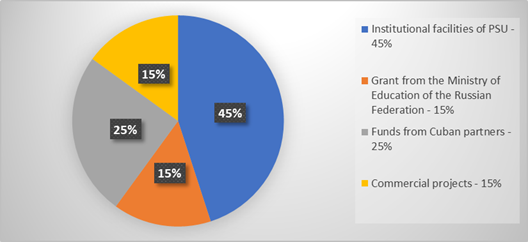
The financial architecture of international educational partnerships represents a critical determinant of their long-term viability and effectiveness. In the context of Russia-Cuba higher education cooperation, establishing a robust and diversified funding framework has proven essential for maintaining program continuity, ensuring quality delivery, and fostering genuine institutional commitment from all stakeholders. The financing model developed for this partnership reflects contemporary best practices in international education collaboration, emphasizing shared responsibility, risk distribution, and sustainable resource allocation (fig. 1).
Fig. 1 - Funding Sources for Cooperation Programs (%)
Source: Compiled by the authors
As it is illustrated in Figure, 1, 70% of the financing is provided through institutional resources from PSU (45%) and funds from Cuban partners (25%), which underscores the mutual interest and investment commitment of both universities. The remaining 30% is generated through external sources – grants from the Russian Ministry of Education (15%) and commercial projects (15%). This co-financing model reduces dependency on a single funding source and demonstrates adherence to the principle of reciprocity, where both parties contribute meaningfully to the shared endeavor.
This diversified approach not only ensures financial stability but also reflects the strategic commitment of institutions to building a sustainable, long-term partnership that can adapt to changing economic and political circumstances while maintaining its core educational objectives. Regarding intraregional cooperation, the need for an inclusive and supportive character stands out (Gacel-Ávila, 2022).
The obtained results convincingly confirm the hypothesis that resource complementarity serves as a key determinant of successful academic collaboration under external constraints. The principle of reciprocity, functioning as an anti-crisis mechanism, has been successfully operationalized in the partnership between Pyatigorsk State University, the University of Camagüey, and the University of Matanzas. This enables the three institutions to co-construct knowledge equally, respect epistemological diversity, and resist dependency on Western-centric models.
Reciprocity as an Anti-Crisis Mechanism
The balanced mobility ratio of 2.5:1, with a trend toward further equilibrium, demonstrates a departure from traditional unidirectional models prevalent in United States and European Union relationships with Latin American and Caribbean countries. This is achieved through resource offset mechanisms: Cuba's developed academic infrastructure and unique cultural assets (e.g., tourism programs) are balanced by PSU's methodological, linguistic, and innovative educational resources (e.g., online Russian as a Foreign Language module, marketing expertise). This model minimizes financial and logistical barriers while creating mutual value. This approach aligns with De Wit & Altbach's (2021) and Elspeth et al. (2021), principle of reciprocity, where partnerships are built on mutual contribution and benefit rather than hierarchical relationships.
Innovation and Adaptability
The development and implementation of formats such as "Pyramid" project teams and hybrid programs demonstrates high institutional adaptability to changing conditions. These formats not only sustain academic mobility but also generate novel, valuable educational products and research collaborations. The dual-degree master's program in tourism exemplifies the integration of theoretical concepts and practical experience from both countries, enriching the learning process and enhancing graduate competitiveness. This reflects the adaptive dimension of Knight's (2020) internationalization model, where universities respond flexibly to external and internal demands.
Development of Intercultural Competencies
The substantial 40% increase in student intercultural competencies represents a critically important outcome. This not only facilitates successful sociocultural adaptation of mobility participants but also establishes a foundation for long-term, deep collaboration. The development of these competencies, consistent with Deardorff's & Tatebayashi’s (2024) framework, enables students and faculty to interact effectively, co-create knowledge, and overcome cultural barriers—forming the bedrock of sustainable international partnerships.
Financial Model Sustainability
The co-financing model (70/30) demonstrates institutional sustainability and mutual commitment. Diversified funding sources, including internal university resources and commercial projects, mitigates risks and ensures long-term program development prospects. This enables the maintenance and scaling of joint initiatives without exclusive reliance on external grants—particularly crucial under conditions of geopolitical instability.
Directions for Future Research
Future research endeavors should primarily focus on developing an innovative model of the Russian-Cuban ‘third space’ in the Russian language research, specifically designed to foster local development in Matanzas Province of Cuba. The model of “Russia-Matanzas Cultural Bridge” is an effective approach to establishing a unique collaborative research environment that integrates linguistic, cultural, and educational methodologies from both nations to promote sustainable regional development through Russian language studies.
The conceptual framework envisions the establishment of a comprehensive scientific-educational linguistic cluster centered on a joint Russian Language and Culture Research Center in Matanzas, supported by bilingual research teams comprising linguists, philologists, and cultural specialists. This initiative would prioritize the development of innovative Russian language teaching methodologies specifically adapted for Cuban language-cultural contexts, comparative studies of Russian and Cuban linguistic cultures, digital learning tools, and investigations into Russian language potential as an instrument for regional economic development.
A critical component of this research direction involves integrating Russian language education into local development strategies through specialized programs targeting key economic sectors. These would include professional Russian language training for tourism and hospitality workers serving Russian tourists, business-oriented language programs for trade and economic cooperation specialists, scientific Russian language preparation for joint research initiatives, and cultural exchange programs supporting creative industries development. The research framework would be supported by a comprehensive digital platform featuring a virtual educational environment with Cuba-specific materials, distance learning systems involving Russian instructors, a specialized Russian-Spanish text corpus reflecting Matanzas regional characteristics, and mobile applications for professional context language learning.
Conclusions
This study analyzed reciprocal internationalization in Russian‑Cuban collaboration (Pyatigorsk State University, University of Camagüey, University of Matanzas). The partnership reveals balanced mobility, innovative program formats, and sustainable financing models amid geopolitical challenges.
Key findings highlight critical dimensions of successful international academic partnerships:
1. Resource Complementarity. Offsetting Cuba’s cultural infrastructure with Russia’s methodological expertise generates balanced partnerships.
2. Intercultural Competency Development. The substantial 40% increase in students' intercultural competencies underscores the transformative potential of reciprocal internationalization. These enhanced skills not only facilitate individual academic mobility but also lay groundwork for long-term, deep institutional relationships.
3. Adaptive collaboration – ‘Pyramid’ project teams and hybrid programs enabled academic engagement under external constraints.
4. Financial Sustainability. Financial sustainability – The co‑financing model (70% institutional, 30% external) ensures continuity.
The Russia‑Cuba case offers an alternative to North‑South academic relationships, emphasizing mutual benefit and strategic resource sharing. Practical implications include a replicable model for universities navigating complex international landscapes. Future research should scale these approaches and assess long‑term impacts. In a transforming international architecture, resource complementarity and mutual advantage are critically essential for sustainable academic partnerships.
Bibliographic references
Bennett, M. J. (1993). Towards ethnorelativism: A developmental model of intercultural sensitivity. En M. Paige (Ed.), Education for the intercultural experience. Intercultural Press.
De Wit, H., & Altbach, P. (2021). Internationalization in higher education: Global trends and recommendations for its future. Policy Reviews in Higher Education, 5(1), 28–46.
Deardorff, D. K., & Tatebayashi, M. (Eds.). (2024). Current perspectives on intercultural and global competence. STAR SCHOLARS PRESS.
Elspeth, J., Leask, B., Brandenburg, U., & de Wit, H. (2021). Global Social Responsibility and the Internationalisation of Higher Education for society. SAGE Journals. Journal of Studies in International Education. 25 (4), 330-347 https://doi.org/10.1177/10283153211031679
Gacel-Ávila, J. (2022). Internacionalización inclusiva en América Latina y el Caribe. Desafíos y factibilidad. Revista Educación Superior y Sociedad, 34 (1), 401-421. Doi: 10.54674/ess.v34i1.570
Knight, J. (2020). The internationalization of higher education scrutinized: International program and provider mobility. Sociologias, 22, 176–199.
Knight, J. (2021a). Higher Education Internationalization: Concepts, Rationales and Frameworks. Revista REDALINT, 1(1). 65-88.
Knight, J. (2021b). Concepts, rationales, and interpretative frameworks in the internationalization of higher education. En D.K. Deardorff, H. de Wit, J. D. Heyl y T. Adams (editores) The SAGE handbook of international higher education. (pp. 27-42.) Sage Publications, Inc. http://dx.doi.org/10.4135/9781452218397.n2
Leask, B. (2014). Internationalizing the curriculum and all students' learning. International Higher Education, 78: Special Issue, 5-6. https://ejournals.bc.edu/index.php/ihe/article/view/5798/5168
Marginson, S. (2006). Dynamics of national and global competition in higher education. Higher Education, 52, 1–39.
Marginson, S. (2023). Limitations of the leading definition of ‘internationalisation’ of higher education: is the idea wrong or is the fault in reality? Routledge Taylor & Francis Group. Globalisation, Societies and Education, https://doi.org/10.1080/14767724.2023.2264223.www.tandfonline.com/journals/cgse20
Institute of Statistical Research and Knowledge Economy NIU VSHE. (2025). Education in numbers. [Statistical Collection]. National Research University Higher School of Economics. https://issek.hse.ru/mirror/pubs/share/1080321503.pdf
Rumbley, L. E., Altbach, P. G., & Reisberg, L. (2012). Internationalization within the Higher Education Context. In D. K. Deardorff, H. De Wit, J. D. Heyl, & T. Adams (Eds.), The SAGE Handbook of International Higher Education (pp. 3-26). SAGE Publications, Inc. https://doi.org/10.4135/9781452218397.n1
Author Contributions
Natalia V. Khomovich: conceptualization, investigation, formal analysis, writing the original draft.
Svetlana A. Khaleeva: writing, review and editing.
Leipzig Rodríguez Medina: writing, review and validation.
Conflict of Interest
The authors declare no conflict of interest.
Atenas Nro. 64 (2026) ISSN: 1682-2749
https://atenas.umcc.cu